Thứ Năm, 30 tháng 7, 2020

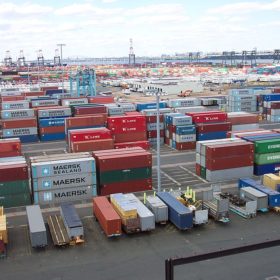
India confirms one-year extension of solar cell import duty

The ‘safeguard’ duty will be levied on Chinese, Vietnamese and Thai solar cells – whether assembled into modules or not – at 14.9% from today and falling to 14.5% in six months’ time. Malaysian products are exempted as their imports have fallen dramatically since the duty was introduced, in July 2018.

The Indian government has decided to follow the recommendation of its Directorate General of Trade Remedies by extending the safeguarding duty on solar cell imports by a year. 

The duty will be levied at 14.9% on cells imported from China, Vietnam and Thailand from today until January 29. After that, it will fall to 14.5% until July 29, according to a Finance Ministry notification.

For the full story, please visit our pv magazine India site.


Lắp đặt điện mặt trời Khải Minh Tech
https://ift.tt/2X7bF6x
0906633505
info.khaiminhtech@gmail.com
80/39 Trần Quang Diệu, Phường 14, Quận 3
Lắp đặt điện mặt trời Khải Minh Tech
https://ift.tt/2ZH4TRU

Red Cloud Renewable (RCR), Solar Energy International (SEI), and Remote Energy (RE) announce continued partnership with All Points North Foundation through the Tribal Train the Trainer (T4) Program

Native Americans Embrace the Sun

A New Way to Honor the Old Ways

###

This program has been made possible through the generous support of All Points North Foundation, The Turner Foundation, In Our Hands, the Carolyn Foundation and many individual contributors to Red Cloud Renewable.

For more information, contact Richard Fox at richard@redcloudrenewable.org or (970) 391-0148. www.redcloudrenewable.org

###


Pine Ridge, South Dakota (July 30, 2020) – Red Cloud Renewable (RCR), Solar Energy International (SEI), and Remote Energy (RE) are pleased to announce our continued partnership with All Points North Foundation through the Tribal Train the Trainer (T4) Program for Solar Certification.

All Point North Foundation’s investment in T4 marked its inauguration in 2019. In Year One, T4 hosted nine Native American Trainers who successfully completed 160 hours of hands-on and theory-based solar PV training and mentoring, and ended with participants taking the North American Board of Certified Energy Practitioners (NABCEP) PV Associates Exam.

Red Cloud Renewable hired two of last year’s T4 graduates as PV Instructors for Red Cloud Renewable Energy Center’s PV training program on Pine Ridge Reservation. RCR Executive Director Henry Red Cloud said, “Marie Kills Warrior and Silas Red Cloud are skilled and exceptionally dedicated solar instructors. We are looking forward to what the future brings for them and the good work they do sharing their solar electric knowledge with other Tribal members.”

Marie Kills Warrior is a member of the Oglala Lakota Tribe and holds the NABCEP Associate Credential. “I look forward to informing other districts on my reservation about Renewable Energy resources with an emphasis on PV,” she said.

Silas Red Cloud of Pine Ridge says that having been around Lakota Solar he saw that it was something great for his kids and for the future, which inspired him to seek certification. Silas stresses the importance of educating the public because many people are interested in a sustainable future, yet don’t know how to contribute towards it. For other Native Americans considering a career in solar, “it’s a great employment opportunity, is good for the environment, and ties into traditional teachings honoring the sun,” he says. Silas is excited to offer it on the homeland and encourages others to do so.

Through All Points North Foundation’s support, the T4 program will expand in Year Two, including formalizing the hands-on training center at Red Cloud Renewable Energy Center with the support of SEI and RE. Retired SEI Co-Founder Johnny Weiss is actively soliciting equipment donations from the industry to create a training center modeled after SEI’s campus in Paonia, Colorado. Additionally, RCR has selected two women and four men representing five tribes and receiving full scholarships for this year’s professional training program that will covers tuition, meals and lodging at the Sacred Earth Lodge, transportation, and the fee for the NABCEP PV Associate’s certification exam. In light of COVID-19 and its devastating impact on Pine Ridge Reservation, training is scheduled tentatively for Spring 2021, with timing dependent on how COVID-19 continues to evolve.

Trainees will learn about the design and installation of grid-tied and battery-based PV systems through classroom and hands-on training. Ongoing mentorship, skill development, and culturally adapted support will build a strong foundation for this program to serve more people in the coming years, bolstering the Native American community‘s solar workforce.

RCR will provide special attention to support solar development efforts on the Yankton Sioux Reservation. According to Henry Red Cloud, “Gail Huebbling and Chris French were two of the founders of the Solar Warrior Society at Yankton, and we want to support them and others there to explore the full spectrum of solar possibilities!”

Red Cloud Renewable is a 501 (c)(3) federally approved non-profit organization headquartered on the Pine Ridge Reservation in South Dakota. Led by Lakota renewable energy leader, Henry Red Cloud, it has provided renewable energy training for thousands of tribal members from more than 50 tribes.

Since 1991, SEI is the premiere solar training organization in the U.S. with more than 76,000 alumni. More than 25% of all North American Board of Certified Energy Practitioners (NABCEP) have received their training through SEI. It has collaborated on solar projects with tribes for more than 15 years.

Remote Energy is a for-impact organization formed in 2017. Its team is dedicated to sharing experience, skills and expertise to empower individuals, communities, technicians and instructors in developing communities worldwide.

All Points North Foundation is one of the first and relatively few foundations in the U.S. to focus specifically on significantly advancing the penetration of photovoltaic (PV) solar through education, job training and the deployment of solar PV technologies. www.AllPointsNorthFoundation.org

###

Media Contact:
Marla Korpar
Solar Energy International (SEI)
www.solarenergy.org
724-989-3964 (c)
970-527-5041 (o)
marla@solarenergy.org


Lắp đặt điện mặt trời Khải Minh Tech
https://ift.tt/2X7bF6x
0906633505
info.khaiminhtech@gmail.com
80/39 Trần Quang Diệu, Phường 14, Quận 3
Lắp đặt điện mặt trời Khải Minh Tech
https://ift.tt/2ZH4TRU

Perovskite structure also benefits batteries

Scientists at Germany’s Karlsruher Institute of Technology are leading an investigation into a new lithium-ion battery anode. The innovation has a perovskite crystalline structure and, according to the researchers, could provide strong all-round performance from simpler, cheaper production methods than those used for other anode materials.

The well-documented shortcomings of today’s lithium-ion batteries have prompted a plethora of new materials to be considered for use in such devices. When it comes to the anode, the aim is to integrate materials with better charge rate and energy density than commonly-used graphite and to find safe ways of using lithium without risking the formation of dendrites.

Lithium-titanate has demonstrated promise and had some commercial uptake but anodes made with the material tend to have lower energy density than graphite and challenges related to cycle life and charge rate.

Scientists led by staff at the Karlsruhe Institute of Technology (KIT) have achieved encouraging results using a lithium lanthanum titanate (LLTO) anode with a perovskite crystalline structure. Their work, with colleagues from China’s Jilin University, is described in the paper Lithium lanthanum titanate perovskite as an anode for lithium ion batteries, published in Nature Communications.

In experiments, the anode achieved a working voltage below 1 V, reversible capacity of 225 milliamp-hours per gram and 79% capacity retention after 3,000 cycles. “Ultimately, cell voltage and storage capacity determine the energy density of a battery,” said Helmut Ehrenberg, head of the Institute for Applied Materials – Energy Storage Systems, at KIT. “In the future, LLTO anodes could enable particularly safe and durable high-performance cells.”

Pseudo-capacitance

The group noted, their anode’s performance was achieved without complex nanoscale engineering. Even with larger particles, the LLTO anode showed better power density and charge rate than lithium titanate oxide, a more commonly researched material.

The researchers put that down to the pseudo-capacitative properties of the LLTO, whereby ions intercalate and transfer their charge into layers of the active material. “Thanks to the larger particles, LLTO enables – in principle – simpler and less expensive methods of electrode production,” said Ehrenberg.

The group said its work highlights the importance of lithium-titanate battery chemistries and added, it hopes to spur new research into the identification and development of other, new titanium-based anode materials with desirable electrochemical properties.


Lắp đặt điện mặt trời Khải Minh Tech
https://ift.tt/2X7bF6x
0906633505
info.khaiminhtech@gmail.com
80/39 Trần Quang Diệu, Phường 14, Quận 3
Lắp đặt điện mặt trời Khải Minh Tech
https://ift.tt/2ZH4TRU

This is your SolarWakeup for July 30th, 2020

No Column. Catch up on this week’s podcast about virtual batteries with the CEO of Extensible Energy. You can find it on your favorite platforms. 

Opinion

Best, Yann

The post This is your SolarWakeup for July 30th, 2020 appeared first on SolarWakeup.com.


Lắp đặt điện mặt trời Khải Minh Tech
https://ift.tt/2X7bF6x
0906633505
info.khaiminhtech@gmail.com
80/39 Trần Quang Diệu, Phường 14, Quận 3
Lắp đặt điện mặt trời Khải Minh Tech
https://ift.tt/2ZH4TRU

Testing floating PV, storage and hydrogen at Netherlands’ largest off-shore wind complex

Energy companies Shell and Eneco have secured the tender to build the 759 MW wind power plant. The partners will build a pilot solar park, short-term storage capacity and a green hydrogen plant at the facility, to assess their capabilities of balancing intermittent power.

Anglo-Dutch energy company Shell and Mitsubishi-owned Dutch utility Eneco have won a government tender to construct the Netherlands’ largest wind power plant – the 759 MW Hollandse Kust (Noord) complex.

The project, planned in the coastal waters of the province of North-Holland, is expected to begin commercial operation in 2023 and will generate around 3.3 TWh per year.

Eneco said five technologies would be trialed at the site which could even out the energy generated by intermittent wind power, including a floating solar park, green hydrogen production, turbines adapted to minimize the negative ‘wake’ effect the structures have on each other and two forms of energy storage, one of which was described as “short-term.” No further details were provided on how the various pilot technologies would be integrated with the wind project.

Turbines

State-owned enterprise agency and tendering authority the Rijksdienst voor Ondernemend Nederland (RVO) said the Hollandse Kust (Noord) wind project will be subsidy-free and will feature 69 Siemens Gamesa 11 MW turbines, each with a 200m rotor diameter, most of which will be sited more than 1km apart. “In principle, the space between the turbines is available for alternative uses provided these are compatible with the wind farm,” stated the agency.

Shell was one of Eneco’s suitors last year but lost out to Mitsubishi.

The Netherlands has two pilot offshore floating PV projects – an array planned in the North Sea, near aquaculture facilities and an offshore wind power farm; and a plant under development by a consortium formed by local research institute the Energy Research Centre of the Netherlands, the Netherlands Organisation for Applied Scientific Research, the Maritime Research Institute Netherlands, the Abu Dhabi National Energy Company and Dutch sea-borne PV specialist Oceans of Energy.


Lắp đặt điện mặt trời Khải Minh Tech
https://ift.tt/2X7bF6x
0906633505
info.khaiminhtech@gmail.com
80/39 Trần Quang Diệu, Phường 14, Quận 3
Lắp đặt điện mặt trời Khải Minh Tech
https://ift.tt/2ZH4TRU

Solar’s warranty risk

The warranty risk of solar must be addressed early in the development phase of PV projects, as it is not possible to buy warranty insurance later during the operational phase. Decisions taken by developers at this stage will remain important for the next 25 years. The good news is that an industry standard exists, and it can be easily and cost-effectively applied to most PV projects, writes Ronald Sastrawan from Munich Re.

From pv magazine 07/2020

Solar PV project developers must address many risks and find solutions to various problems. During the development phase, a developer will be heavily engaged in obtaining financing, the correct PPA, EPC and O&M contracts, required permits, land leases, and so on. Given this, “warranty-related risks” for PV modules are probably not at the top a developer’s priority list. However, it is at this stage that warranty risk should be addressed, and there are solutions at hand.

Key takeaways

Warranty risk in solar is correctly addressed during the PV module procurement phase. The first layer of PV warranty insurance comes with sourcing warranty-insured PV modules. The structure of the insurance should be assessed from the perspective of the project developer. This means that the insurance limit (maximum payout in US$) should be known and dedicated exclusively to the specific project, as it should not be shared in a pool with other projects. Also, the insurance liability period should match the warranty period, without any reduction of limit over time. Written confirmation of insurance with the name of the project owner (beneficiary) should be provided by the insurance company.

An optional “top-up cover” can be placed to increase the limit, and generally broaden the cover. This top-up cover should be discussed directly with the insurance company, so it can be tailored to specific requirements. The project owner will handle all warranty claims with the supplier and the supplier will be indemnified by the insurance. Only in the event of the supplier’s default, will the warranty claims be directly handled between the project owner and the insurance company.

Module warranties

The due diligence on the PV module revolves around a key question: “Will the modules perform according to the warranty, and will my project receive indemnification in the event of module underperformance?”

Therefore, the warranty itself should be studied. A common standard is a guaranteed annual degradation of not more than 0.7% for 25 years. Double-glass modules can come with guaranteed annual degradation of less than 0.5% for 30 years. The two most important possibilities for indemnification are (i) replacement of the modules, or (ii) compensation – either via modules or financially – of the missing Wp of the underperforming modules. Of course, repair of the modules is also an option. Cost of transport, installation, and testing may or may not be covered under the warranty.

PV module warranties are a very important and strong guarantee, from the supplier to the project owner, for the next 25 or 30 years. Financial models heavily depend on them as a result. But who is actually liable if a supplier eventually goes out of business?

Warranty risk

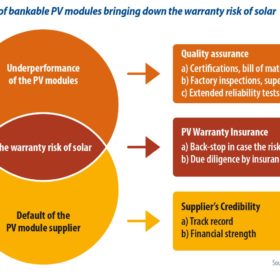
A warranty risk event is defined as the occurrence of a warranty claim in combination with the event that the PV module supplier has ceased operations. The long warranty period of PV modules poses a unique opportunity, but also a unique risk to the PV industry. There is a very real likelihood that a developer or project owner may be left alone with the useless warranties of an insolvent module supplier during the long operational phase of the project. PV warranty insurance is placed to cover this risk.

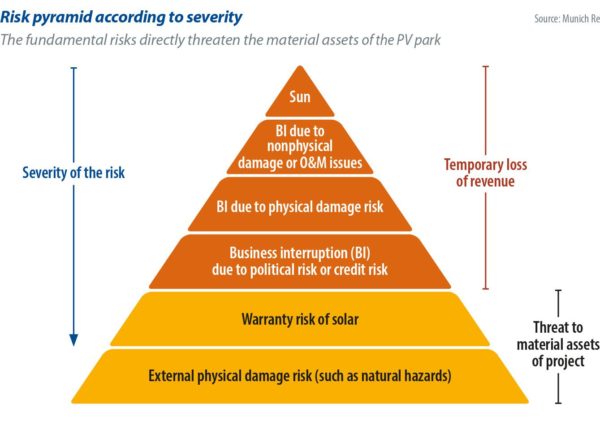
Warranty risk is a fundamental risk in PV projects. It is on a similar level as physical damage due to natural hazards, a direct threat to the PV components themselves. However, unlike natural hazards, it cannot be insured against on an annual basis, because the risk changes over time, and generally increases in later years. There would be no guarantee of annual renewal during the time when it is most needed.

Therefore, PV warranty insurance – as one key feature of sustainable PV projects – is a long-term contract and must be addressed early: during the procurement process of the modules. It should be noted that warranty insurance does not replace the due diligence process on the PV modules. It is just one important feature, among others, of de-risking PV warranties.

First layer

The first layer of PV warranty insurance comes with sourcing warranty-insured PV modules and needs to be requested directly from the PV module supplier. One place to find suppliers that are eligible to sell warranty-insured PV modules is Munich Re’s PV Warranty Partner List. To become eligible, the listed suppliers must regularly pass a due diligence process and insure at least 100 MWp annually – usually much more is insured.

But even if the supplier is not listed, a solar PV developer can – and should – request warranty-insured modules. The supplier can then apply for assessment or offer a solution from another insurance provider. At this stage, due to the long-term tail of the coverage, it is of particular importance to be aware of the financial rating of the (re-) insurer.

Furthermore, as warranty insurance comes in different shapes and sizes, it is important to understand the basics of how the warranty insurance of the component supplier is structured. The most important questions are:

“How much insurance capacity (in USD) belongs to the particular project on which I am working (the limit)?” This limit will be the maximum payout to the project from the insurance and is usually far below 100% of the modules’ sales value.

“Is the insurance capacity exclusively dedicated to my project, or is my project one of many with access to a shared pool?” The latter would result in a “first come, first served” problem. This “shared pool” structure exists in the market, and while viable from the PV module supplier’s perspective, it should be avoided from the project developer’s perspective. It is important that a solar developer “owns” its limit.

“Do I get a true 25- or 30-year cover, or is the limit reduced after year 10 or 12?” A 10- or 12-year cover period – with a limit reduction in later years – might be acceptable for certain projects, but in general, the insurance should cover the full warranty period.

“How high is the deductible for the specific PV project?” The deductible should relate to the size of the park. The deductible is an important parameter to keep the insurance premium low by filtering non-critical (small) claim scenarios.

“Does the warranty insurance transfer to me, the project owner, in the event of the supplier’s default?” Obviously, this is a key point, and written confirmation with the name of the project owner (beneficiary) should be provided by the insurance company (via the supplier) for each project owner individually. This confirmation letter can then be shown to the various stakeholders. If ownership of the project changes, the change of beneficiary must be reported to the insurance company to update this information.

It is useful, to state the most important conditions in the relevant documents, such as purchase agreement or term sheet (see the box to the right).

Most module suppliers are able to provide warranty-insured modules with the above conditions, as this is a standard in the market. Currently, a limit of not less than 5% but not more than 10% of module value for the full 25 or 30 years cover is common in the market. A deductible of not more than 5% is common.

These parameters are subject to change as market conditions change. Depending on the limit and the market conditions, this first layer should not affect costs too much, if at all.

Important Conditions

  1. Supplier shall obtain PV warranty insurance with the following specifications:
    1. Insurance Limit of at least [x%] of the module value dedicated exclusively to this project (project-specific).
    2. Insurance Limit for [yy] years, which does not decrease in later years and is non-cancellable.
    3. Coverage transfers to the project owner in the event of supplier’s default.
    4. (Re-) insurer has financial rating of [e.g. at least AA- by S&P].
  2. Supplier shall provide written Confirmation of Insurance by the insurance company stating the name, location, size of the project, and the beneficiary’s name within one month, but no later than first module shipment.

Second layer

Certain projects require a higher limit than is provided by the supplier’s warranty insurance. Under current market conditions, it is not feasible for module suppliers to provide higher insurance limits, and for most projects, a limit of 5% to 10% has proven acceptable.
Nevertheless, optional top-up cover is required for certain projects. A top-up cover is intended to increase the limit and has the option to include cost of transport, installation, and testing. The possibility of covering loss of revenue due to the underperforming modules also exists.

The top-up cover can be placed in a very easy and fast process, given that the underlying first layer is already placed. However, it needs to be tailored to the specific requirements of the project, so these should be discussed directly with the insurance company.

The insurance premium for the first layer is paid by the supplier and should not affect costs too much, if at all. The second layer is usually paid by the project developer and strongly depends on the specific requirements, mainly the limit. Once the premium is paid, the cover is active for the whole liability period of 25 or 30 years.

If the supplier is operating normally, all warranty claims should be addressed to the supplier. The supplier will handle all the warranty claims with the project owner and also with the insurance. The insurance will pay indemnification to the supplier and may get involved in verifying the warranty claim.

If the supplier is in default or has ceased operations, the insurance company should be contacted directly. Depending on the situation, a third party expert might get involved to verify the claim. Financial indemnification will be paid directly from the insurance company to the beneficiary stated in the confirmation of insurance.

Assurance and insurance

The warranty risk of solar can be mitigated easily and cost-effectively by correctly applying existing insurance standards during the procurement process of the modules. PV warranty insurance is one key feature of de-risking PV warranties, and crucial to curtail financial losses of a warranty risk event.

Warranty insurance does not replace the project developer’s due diligence and is no substitute for regular monitoring, inspection and testing of the PV modules during the operational phase. These serve as early detection mechanisms for potential warranty claims. Preventive action is always the best option, as the maximum insurance payout – with or without top-up cover – might not cover all losses.

In addition to providing indemnification during a warranty risk event, PV warranty insurance can be an advantage when a project is being sold or refinanced. Especially if the PV module supplier has since ceased operations, or quality issues of similar PV modules in other projects have been reported, an existing PV warranty insurance, especially with a strong top-up cover, can make a big difference.
About the author

Ronald Sastrawan is director of green tech solutions at Munich Re, insuring long-term risks for suppliers and developers of clean technologies. Sastrawan developed Munich Re’s PV Warranty Partner program. The program won the APVIA award for the best banking and financing initiative. It provided more than €100 million of insurance capacity in support of roughly €1 billion of solar investments within the first year of its rollout. Sastrawan has more than 15 years of experience in the solar industry. After his PhD in physics at Fraunhofer ISE, he set up factories for solar cell production in Asia and the United States. Prior to joining the Munich Re Group, he headed an R&D team in the solar production equipment industry.


Lắp đặt điện mặt trời Khải Minh Tech
https://ift.tt/2X7bF6x
0906633505
info.khaiminhtech@gmail.com
80/39 Trần Quang Diệu, Phường 14, Quận 3
Lắp đặt điện mặt trời Khải Minh Tech
https://ift.tt/2ZH4TRU

Aid organization seeks developers for minigrids in Ethiopia

U.S.-based Mercy Corps has launched a call for expression of interest in the installation of minigrids at three refugee camps on the border with Somalia.

Mercy Corps,, a U.S.-based aid organization, has launched a call for expression of interest to design, build and operate several minigrids at three refugee camps around Jigjiga, a city in the Somali Region of Ethiopia.

The selected developer will have to assess the solar resource potential of the three camps, estimate required energy demand, and investigate land options for the minigrids at the site.

The offgrid installations should be designed for easy expansion and integration into the national grid in the future, the organization said. The closing date for the submission of proposals is Aug. 5.

The three camps hosts refugees  from southern, central and northwestern Somalia. According to the United Nations High Commissioner for Refugees (UNHCR), around 37,477 persons lived at the sites in February. This includes 14,951 refugees in the Kebribeyah camp, 12,120 at the Aw Barre site, and 11,994 at the Sheder facility.

Ethiopia’s cumulative installed PV capacity stood at just 11 MW at the end of 2019, according to the International Renewable Energy Agency (IRENA).


Lắp đặt điện mặt trời Khải Minh Tech
https://ift.tt/2X7bF6x
0906633505
info.khaiminhtech@gmail.com
80/39 Trần Quang Diệu, Phường 14, Quận 3
Lắp đặt điện mặt trời Khải Minh Tech
https://ift.tt/2ZH4TRU