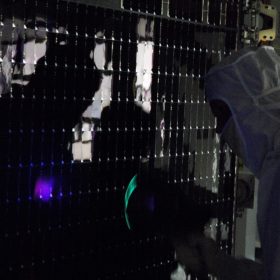
Researchers in France have tried to predict the competitiveness of tandem PV modules against commercial crystalline products in 2030. Crystalline products will be 22-24% efficient in a decade, according to the researchers, possibly 25% if interdigitated back-contact and heterojunction versions become mainstream. To compete, tandem devices will need to offer similar life spans and degradation rates, plus efficiencies of 30%.
PV modules made with tandem solar cells will have to show efficiencies of 30% and offer the same lifetime and degradation rate as standard crystalline panels if manufacturers want to hit commercial production.
That is one of the main findings of the paper IPVF’s PV technology vision for 2030, by researchers at French technology institute L’Institut Photovoltaïque d’Île-de-France (IPVF), and published in Progress in Photovoltaics.
According to the paper – which assesses the potential competitiveness of tandem modules against crystalline silicon products – commercial versions of the latter will reach efficiencies of 22-24% by the end of the decade, and possibly 25% if interdigitated back-contact (IBC) heterojunction products reach commercial production. Crystalline products are expected to cost less than $0.15/W by 2030, have a theoretical maximum efficiency of 29.4% and boast a 0.5% annual degradation rate over a 30-year lifetime.
Perovskites
In that scenario, said the researchers, tandem devices would require a new bill of materials, with perovskites potentially saving them from being consigned to history. “We anticipate that perovskite on c‐Si [crystalline silicon] tandem modules, which can build upon a [more-than] 100 GW c‐Si module production base, might first be deployed in constrained-area markets as a premium product, competing with SHJ [silicon heterojunction] and IBC premium c‐Si modules,” the academics wrote.
Drawing on a production base of such scale, perovskite-based tandem devices might be able to compete by topping 30% efficiency and offering a similar degradation rate and lifespan as their crystalline silicon rivals. In that scenario, tandem products could cost just $0.05-0.10/W more than crystalline devices, according to the researchers.
Gallium arsenide (GaAs) III-V solar cells have already topped 32% efficiency in laboratories, the IPVF group noted. “However, there is a critical cost issue with III‐V materials that is being currently addressed, e.g. by developing lower‐cost deposition methods such as hydride vapor phase epitaxy,” said the researchers.
Perovskite tandem solar cells have thus far reached efficiencies of around 28%.
Lắp đặt điện mặt trời Khải Minh Tech
https://ift.tt/2X7bF6x
0906633505
info.khaiminhtech@gmail.com
80/39 Trần Quang Diệu, Phường 14, Quận 3
Lắp đặt điện mặt trời Khải Minh Tech
https://ift.tt/2ZH4TRU

Không có nhận xét nào:
Đăng nhận xét