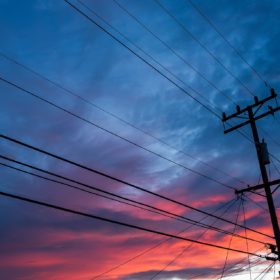
A recent project milestone saw the disconnection of properties from overhead lines and will enable 64km of poles and wires to be replaced by off-grid solar-plus-battery solutions.
From pv magazine Australia.
Western Australia’s government-owned utility Horizon Power has become the first in the nation to remove parts of its overhead network and replace them with an off-grid renewable energy alternative – in this case solar. The utility is installing 17 standalone power systems on fringe-of-grid properties east of Esperance, with a focus on regional farms susceptible to outages.
With solar panels, batteries, inverters and back-up diesel generators, the standalone power systems not only reduce grid infrastructure spending but reduce the chance of bushfires caused by lightning strikes and of accidents caused by farm machinery operating near overhead lines.
Horizon unveiled its off-grid program this year with plans to install 13 off-grid power systems and replace 54km of ageing wires and poles. The utility has since expanded its program with plans for 17 units for customers in the Neridup and Beaumont farming areas in the Goldfields-Esperance region which will enable the removal of 64km of poles and wires this year.
Bushfire prevention
The project yesterday reached a milestone with the disconnection of properties from overhead lines. Horizon Power CEO Stephanie Unwin said standalone power is a viable alternative in remote locations where poles and wires are experiencing frequent and prolonged outages caused by lightning strikes, bush fires, vegetation and bird strikes. “We only have to look back to the fires of 2015 to see how important this new energy solution can be for the safety of a community,” she said. “Over the last three years we have successfully demonstrated technologies such as SPS [solar power systems], which improves [the] reliability of power supply and safety for our customers and can offer sustainable energy solutions at a lower cost than traditional solutions.”
State energy minister Bill Johnston yesterday visited a property in Neridup to see one of the new off-grid systems. “The energy sector is undergoing a significant transformation which is mainly driven by the rapid uptake of solar panels and battery storage systems at homes,” the minister said. “Improving our energy sector in Western Australia is essential and overdue, which is why the McGowan government launched its Energy Transformation Strategy earlier this year.”
In Western Australia, standalone power systems are an attractive proposition. This year, state grid operator Western Power announced it was set to roll out 57 such systems at farms, having inked $8.8 million (US$5.95 million) in contracts for the first stage of its landmark off-grid program for regional properties. Servicing the units for their working life will save Western Power almost $6 million compared to the network refurbishment which would otherwise be needed to ensure reliable power supply to rural properties in off or edge-of-grid areas.
That off-grid roll-out built on a standalone power trial program launched by Western Power at six farms in the Great Southern region in 2016. The trial found an average 70 hours of power outages were avoided in its first year and a whopping 92% of the affected properties’ power supply could be met by solar – buffered by battery storage.
Reforms needed
The Australian Energy Market Commission (AEMC) has recommended changes at a federal level which would enable off-grid systems to supply power to remote areas. While consumers can currently go “off-grid”, they do so at their own expense and in most cases have limited consumer protection. The AEMC has recommended the Council of Australian Governments’ energy council require distribution networks to identify opportunities for standalone systems and work with customers where a transition to off-grid power makes sense.
“The old-fashioned way of centralized generation being distributed by stringing poles and wires to the remote corners of Australia is giving way to solar and battery systems where energy is generated closer to where it is used,” AEMC chief executive Anne Pearson said. “These reforms mean that people living at the end of the line will get a better quality service with the same protections without paying any more.”
Trials of standalone power systems are under way in several states including New South Wales and Queensland.
Lắp đặt điện mặt trời Khải Minh Tech
https://ift.tt/2X7bF6x
0906633505
info.khaiminhtech@gmail.com
80/39 Trần Quang Diệu, Phường 14, Quận 3
Lắp đặt điện mặt trời Khải Minh Tech
https://ift.tt/2ZH4TRU

Không có nhận xét nào:
Đăng nhận xét