Thứ Năm, 1 tháng 10, 2020

This is your SolarWakeup for October 1st, 2020

Monopoly Overreach And Insanity. This got my blood pressure up early yesterday when Twitter started circulating the news that NextEra approached Duke with the intention to acquire the Carolina utility. Even though Duke is based in Charlotte, it has operations in North and South Carolina as well as Florida. NextEra which already has well over 50% of Florida’s consumers can’t get enough when it comes to a regulated non-competitive market. Imagine the power that such a utility would have across the Southeast, politicians would have to allow them to do anything because what other choice would they have? This is incredibly dangerous but entirely plausible.

Nonstationary Power. When Tesla first released the power wall they called that division stationary power. I publicly opined on this platform years ago that stationary power implies non-stationary power to be on the auto side of the company. Delaware had done a vehicle to grid pilot a few years ago and Enel has been showing off their programs in Italy online. With the CPUC enabling some testing of V2G we’ll look a bit into how that overlaps with the solar industry. Homes with EVs often have 70kWh plus in their driveway, it makes sense to have the ability to use that energy in certain situations.

Speaking Of EVs. Do any SolarWakeup readers know anything about ev conversions for internal combustion vehicles? Please reach out and share your tips.

Solar Market Update Call. The solar market can be considered complex and fast moving but if you join this monthly market call you can make sense of it. Register for the next Roth Capital solar market call on October 2nd at 10am Eastern.

Get The Power. Later this year, the residential solar market is going to get some major savings with most of their balance of systems when the shift to higher power solar modules really gets going. With power density going up more than 10%, those savings will trickle down to mounts, rails, inverters, labor and wire and hopefully into installers’ wallets. Make sure you are getting the best modules and pricing possible by joining the SolarWakeup Buyer’s Group. You can see the pricing on our price discovery page.

Opinion

Best, Yann

The post This is your SolarWakeup for October 1st, 2020 appeared first on SolarWakeup.com.


Lắp đặt điện mặt trời Khải Minh Tech
https://ift.tt/2X7bF6x
0906633505
info.khaiminhtech@gmail.com
80/39 Trần Quang Diệu, Phường 14, Quận 3
Lắp đặt điện mặt trời Khải Minh Tech
https://ift.tt/2ZH4TRU

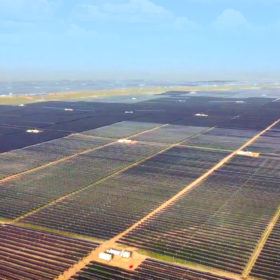
World’s largest solar plant goes online in China

Huanghe Hydropower Development has connected a 2.2 GW solar plant to the grid in the desert in China’s remote Qinghai province. The project is backed by 202.8 MW/MWh of storage.

Chinese state-owned utility Huanghe Hydropower Development has finished building the world’s largest solar power project in a desert in the northwestern Chinese province of Qinghai.

Chinese inverter manufacturer Sungrow, which supplied the inverters, said that the 2.2 GW solar plant was built in five phases. It involved an investment of RMB15.04 billion ($2.2 billion) and includes 202.8 MW/MWh of storage capacity. The company announced the storage system as a solar+storage project in mid-May, but at the time it did not reveal that it was to be connected to a giant solar plant.

The project was built with monocrystalline bifacial modules, supplied by an unnamed manufacturer, and 900 MW of Sungrow’s SG250HX 1,500 V string inverters. “Sungrow supplied the highly integrated energy storage system, features AC-coupled, low-voltage design, which can increase the utilization of the transformer, guaranteeing a lower system cost,” the company told pv magazine. 

Construction of the PV plant began in November 2019 and was completed in September. The storage system was deployed within four months, from May to September. The installation will sell power to the local grid at a price of RMB0.34/kWh.

The complex is connected to an ultra-high voltage power line that State Grid Corp. of China is building to connect the far northwestern parts of the country to the more densely populated eastern provinces. The RMB22.6 billion power line project will include the construction of two converter stations with 8 GW of transmission capacity. The line will extend 1,587 kilometers across Qinghai, Gansu, Shaanxi and Henan provinces.


Lắp đặt điện mặt trời Khải Minh Tech
https://ift.tt/2X7bF6x
0906633505
info.khaiminhtech@gmail.com
80/39 Trần Quang Diệu, Phường 14, Quận 3
Lắp đặt điện mặt trời Khải Minh Tech
https://ift.tt/2ZH4TRU
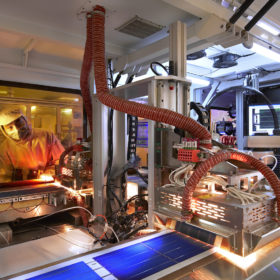
Trina kicks off production of 550 W panels

The PV module manufacturer has started mass production of its Vertex 550 W ultra-high-power modules at its factory in China's Jiangsu province. It expects to start manufacturing 600 W panels in the first quarter of next year.

Trina Solar said this week that it has started producing its Vertex solar panels – featuring 550 W of power output – at its new factory in Yancheng, in China’s Jiangsu province.

“The mass production of the 550 W module is a milestone in speeding up the industrialization of ultra-high power module technological innovations and their application,” said the Chinese manufacturer. “Vertex 550 W ultra-high power modules contain three key advanced technologies, including multi-bus grid, non-destructive cutting and high-density packaging.”

The manufacturer launched its first 500 W-plus solar panels in February. It also recently revealed that its Vertex 600 W/550 W modules had passed TÜV Rheinland’s comprehensive reliability test.

Trina unveiled the 600 W Vertex panels in mid-July. At the time, the Changzhou-based company said that production of the 600 W version would start in the first quarter of 2021. It said it will install 10 GW of annual Vertex production capacity this year, rising to 21 GW next year and 31 GW in 2022.


Lắp đặt điện mặt trời Khải Minh Tech
https://ift.tt/2X7bF6x
0906633505
info.khaiminhtech@gmail.com
80/39 Trần Quang Diệu, Phường 14, Quận 3
Lắp đặt điện mặt trời Khải Minh Tech
https://ift.tt/2ZH4TRU

Huawei brings PV batteries to Europe

The Chinese group is now presenting its Luna2000 photovoltaic storage system on a roadshow across Germany. It will start sales with a number of partners later this year in several European countries.

Huawei will soon start offering its Luna2000 home energy-storage system for residential PV systems throughout Europe.

The inverter manufacturer said that the storage solution will be available in Germany by the end of this year, as well as other unspecified European markets.

It is currently presenting its new product on a roadshow across Germany and claims that it is generating significant consumer interest. It will run the roadshow at a number of different locations until the end of October.

The modular Luna2000 storage solution is available in three versions. The smallest variant has a capacity of 5 kWh, with a maximum discharge capacity of 3.5 kW. The other two versions have capacities of 10 kWh and 15 kWh, with maximum discharge capacities of 7 kW. They weigh between 63.8 kg and 163.8 kg.

The Luna2000 system can be combined with Huawei single-phase and three-phase inverters. The company uses lithium iron phosphate cells, with a maximum of two batteries running in parallel for a maximum of 30 kWh of potential storage capacity. 

Huawei relies on a multilevel security concept that extends from the cell chemistry and sensor technologies to the battery unit itself, as well as the entire storage system and inverters. Each battery unit has its own management system and comes with a 10-year guarantee.

The storage solution can be installed on a stand or can be mounted on walls. Huawei is primarily targeting the residential PV segment, but the Luna2000 system can also be used in small commercial applications. It has yet to disclose prices, however, other than to claim that the systems will be sold at “very attractive” prices. 


Lắp đặt điện mặt trời Khải Minh Tech
https://ift.tt/2X7bF6x
0906633505
info.khaiminhtech@gmail.com
80/39 Trần Quang Diệu, Phường 14, Quận 3
Lắp đặt điện mặt trời Khải Minh Tech
https://ift.tt/2ZH4TRU

UN SDG: Affordable & Clean Energy

UN SDG: Affordable & Clean Energy for all A promise of access to affordable, reliable, sustainable and clean energy for all. This month lets talk about some of the 17 United Nations Sustainable Development Goals and see what role can we play by doing our bit for th read more


Lắp đặt điện mặt trời Khải Minh Tech
https://ift.tt/2X7bF6x
0906633505
info.khaiminhtech@gmail.com
80/39 Trần Quang Diệu, Phường 14, Quận 3
Lắp đặt điện mặt trời Khải Minh Tech
https://ift.tt/2ZH4TRU

First Parish Rallies Around Solar and Community

It’s not easy to reach a consensus in a large group of people. Yet for First Parish Church of Milton, MA not only did their democratic congregation vote to solarize the roof of their historic church building, they did it unanimously.

“It was the first unanimous vote in my memory, and I’ve been with the church for fifteen years,” says Tony Dutzik. A member of the Parish Committee, Tony is one of the parishioners on the church’s Solar Task Force that came together to turn the church’s aspirations of solar energy into reality.

Putting Responsibility First

Talks about solar energy began for the church in 2018 with the congregation rallying around it after a long process of research and education, but First Parish has been striving for environmental responsibility long before that. It’s an issue close to their hearts. Their cherished church building is a late 18th century structure, and energy efficiency upgrades such as air sealing and efficient lighting have both helped improve energy costs and comfort of the building, without compromising its character.

Their solar array they wanted to be sure would do the same. They chose all-black panels rather than blue, with black frames to blend with the shingle roof and fit the aesthetic of the church. They put out an RFP for the project, won by Resonant Energy who then brought in ReVision Energy to handle the install of the 173-panel solar array that spans the rooftops of the main building and outbuildings.

Due to Covid-19, they haven’t been able to resume programming in their buildings yet, so few people were on site for the install, but Tony notes that the process was quick and smooth. And when the install was complete, they were pleasantly surprised with how well the array meshed with the buildings. “The panels blend into the historical character of the church so well, they look like they were there from the beginning,” he says.

Community Investment…

As a nonprofit unable to take advantage of tax credits, First Parish got creative with fundraising to make financing the large solar project more feasible. They asked members of the congregation to “buy” a panel, or a portion of a panel which they could dedicate to their loved ones, and were met with a surge of support. This fundraising effort alone covered a full third of the total system cost.

Now installed, the array itself will help cut costs going forward. “Like any nonprofit, we have to balance services with contributions that our members can make,” says Tony. “Having a long-term reduction in our operating costs directly enables us to do more for our congregation and have a greater social impact.”

Their 61.8-kilowatt solar array will produce roughly 120% of their annual energy needs, a deliberate oversizing of their system that plays directly into their values of environmental and social responsibility as a Unitarian Universalist church. “Tradition calls on us to respect and value the interconnected web of life that sustains us all. It’s really the core to our shared faith together,” says Tony.

… And Community Benefit

One way those values manifest is through sharing of their electricity production. Massachusetts’ Community Solar Program enables them to allocate excess power to two community partners – Unitarian Universalist Ministry in Roxbury, and their neighbors in Milton, the First Congregational Church. “We are in essence selling our excess electricity at a discount to partners doing good work in the community. It’s a win-win,” says Tony.

Meanwhile, the project itself has had a surprising impact in this socially distant time. While the congregation has been able to stay in touch online, they are missing that sense of community from being together in person. They were finally able to organize their first in-person event since Covid – an outdoor celebration of the completed installation of their solar array this September. “Coming together around this solar project provided a sense of community,” says Tony. “It’s really made a difference in ways you can’t tally up in dollars and cents.”

The post First Parish Rallies Around Solar and Community appeared first on ReVision Energy.


Lắp đặt điện mặt trời Khải Minh Tech
https://ift.tt/2X7bF6x
0906633505
info.khaiminhtech@gmail.com
80/39 Trần Quang Diệu, Phường 14, Quận 3
Lắp đặt điện mặt trời Khải Minh Tech
https://ift.tt/2ZH4TRU

Duke Energy Receives Floating Solar Contract from Fort Bragg

The U.S. Army’s Fort Bragg in North Carolina will soon be home to the largest floating solar plant in the Southeast – a 1.1 MW system as part of a Utility Energy Service Contract (UESC) awarded to Duke Energy.

The $36 million contract will focus on energy resilience and security at Fort Bragg: infrastructure modernization including lighting and water upgrades, heating, ventilation and air-conditioning, and boiler system improvements.

“As a leader in solar energy, we’re excited to bring this unique project to Fort Bragg,” says Melisa Johns, vice president of distributed energy solutions at Duke Energy. “This project takes a comprehensive look at the way energy is being used at Fort Bragg and will lead to more efficient energy use and significant cost savings.”

Ameresco, Duke Energy’s prime contractor, will build the 1.1 MW floating solar PV system on the Big Muddy Lake located at Camp Mackall. Fort Bragg will own and operate the system once construction is completed. Construction is expected to begin in November.

The floating solar installation will be paired with a 2 MW battery energy storage system. The system will supplement power to Fort Bragg from the local grid and provide backup power during electric service outages.

Floating solar power could have a big future. The U.S. Department of Energy’s National Renewable Energy Laboratory (NREL) researchers estimate that installing floating solar photovoltaics on the more than 24,000 man-made U.S. reservoirs could generate about 10% of the nation’s annual electricity production. Currently, floating solar makes up only about 1-2% of the world’s solar capacity.

The project is part of Duke Energy’s federal business, which develops and delivers solutions that strengthen infrastructure reliability, operational resilience and energy cost performance. Duke Energy recognizes that federal and military energy infrastructure needs are diverse and uniquely complex.

The post Duke Energy Receives Floating Solar Contract from Fort Bragg appeared first on Solar Industry.


Lắp đặt điện mặt trời Khải Minh Tech
https://ift.tt/2X7bF6x
0906633505
info.khaiminhtech@gmail.com
80/39 Trần Quang Diệu, Phường 14, Quận 3
Lắp đặt điện mặt trời Khải Minh Tech
https://ift.tt/2ZH4TRU