
Thứ Bảy, 14 tháng 11, 2020

The weekend read: Behind the curve

Even as solar installations continue to grow and renewables make their way further into the energy mix, a look at the bigger energy picture reveals a worrying lack of commitment among utilities to a transition away from fossil fuels. This was the conclusion of researchers at Oxford University, who found that globally, less than half of all utilities have prioritized the development of renewables over the past 20 years. Even among those that have focused on solar and wind, just 15% actually reduced commitments to fossil fuels at the same time.

From pv magazine 11/2020

A global shift to clean energy is already underway, with wind, solar, and other power sources growing in capacity each year. Renewables are set to overtake coal and gas to account for the largest share of the global energy mix before 2040, according to International Energy Agency predictions.

A look back over the past 20 years shows that the development of renewable energy has so far been driven by independent power producers, which are estimated to own three-quarters of non-hydro renewables capacity globally. Electric utility companies, meanwhile, have been much slower to pick up on the shift, owning around 19% of that capacity, and in many cases continuing to invest heavily in coal and gas generation.

“Although there have been a few high-profile examples of individual electric utilities investing in renewables, overall the sector is making the transition to clean energy slowly or not at all,” says Galina Alova, a researcher at Oxford University and author of a study analyzing utility investments. “Utilities’ continued investment in fossil fuels leaves them at risk of stranded assets – where power plants will need to be retired early – and undermines global efforts to tackle climate change.”

Bigger picture

The study led by Alova took in the activities of more than 3,000 utilities between 2001 and 2018. The data was collated from the World Electric Power Plants Database published by S&P Global Market Intelligence – estimated to contain unit-level data on around 109,500 power plants operated by 42,000 companies. “What’s really valuable about this data set is the historical lens that it allows to look through,” says Galova. “Often, asset-level data sets have the latest snapshots of the power generation sector, but not necessarily going back decades back. So this is quite a unique data set.”

This data was then analyzed and arranged into “clusters” of similar data points using a machine-learning technique. The study, “A global analysis of the progress and failure of electric utilities to adapt their portfolios of power-generation assets to the energy transition,” was published in Nature Energy.

The research revealed four major trends among all of the utilities and multiple sub-patterns within them. The largest chunk – more than 75% of the companies, representing 50% of the overall capacity – were so-called “passive” players, as they are neither actively growing renewables nor expanding their fossil fuel portfolios.

The second-largest cluster, which primarily featured bigger utilities with larger market shares in their respective countries, included companies that prioritized growth in renewables over other technologies. They represented 10% of all the utilities and 26% of the overall capacity. The study’s key finding was that 57% of these renewables-prioritizing companies had continued to invest in gas, coal, or both, while 80% expanded their commitments to gas generation by an average of 5%. About 35% increased investments in coal at a rate of 1%. While 34% of the renewables-prioritizing cluster showed negative growth in coal and gas, just 15% cut both from their portfolios. Around 16% of the cluster have 46 GW of gas projects in their pipelines, while 7% have new coal projects, adding up to 36.5 GW.

The third and fourth clusters identified were those prioritizing gas – 10% of utilities and 19% of capacity – and a smaller cluster prioritizing coal generation investment. This made up 2% of the companies and 5% of capacity.

Regional trends

The largest countries represented in the RE-prioritizing cluster were the United States (29%), Germany (13%), and China (10%). Europe and North America collectively accounted for more than two-thirds of the cluster. The highest growth in utility gas investments was seen in the Middle East region, while Asian utilities led investments in coal generation. Of the 15% that had reduced investments in both coal and gas, more than 40% were located in European countries.

Utilities prioritizing gas were spread across regions, with North America representing 30%, Europe 26%, and Asia 13%. The coal prioritizers, meanwhile, were overwhelmingly (82%) located in Asia, with China alone contributing 60%, India 9%, and Vietnam 6%.

Market liberalizations emerged as one driver for growth in utility-owned renewables. Regions where independent power producers and other non-utility actors have invested in solar or wind capacity also saw more activity on renewables from utilities. And the study also points to policy as an important factor, with more than 60% of the RE-prioritizing utilities located in regions with an active feed-in-tariff for renewable energy, and close to half in jurisdictions with some form of renewable portfolio standard. Of the already small number of utilities prioritizing coal, just 6% were located in regions with a carbon tax policy and 3% in jurisdictions with an emissions trading scheme in place.

Shifting priorities

In 2001, the beginning of the period examined, Alova notes that 18% of global operating energy capacity was covered by some form of RE promoting or fossil fuel inhibiting policy. By the end of the study in 2018, this had risen to 85%.

And when the 18 years studied are divided into six-year sub-periods, some evidence of shifting priorities can be seen. Between the second and third periods, 16% of previously gas prioritizing and 8% of coal prioritizing companies made their way into the RE-prioritizing group.

To gain an even more in-depth understanding of the relationship utilities have with renewables, Alova says that the relative price of the different technologies and the financial performance of the utilities would merit further study, and a closer look at the relationship between policy and the actions of utilities. “The effectiveness of a policy often depends on its design and complementarity with other instruments,” she explains, “rather than its mere existence.”

The majority of utilities studied grew neither their fossil fuel nor renewable energy assets during the 18 years analyzed. A market shift toward independent power producers and utilities acting as off-takers provides a possible explanation for this. Alova also notes that utility activities in energy efficiency, decentralization and other non-generation activities could somewhat change the picture.

The analysis conducted here, however, points to a major global trend of continued investment in fossil fuels from utilities, one which sees them lagging behind other players in the energy transition and taking the risk of these investments becoming stranded assets in the years to come.


Lắp đặt điện mặt trời Khải Minh Tech
https://ift.tt/2X7bF6x
0906633505
info.khaiminhtech@gmail.com
80/39 Trần Quang Diệu, Phường 14, Quận 3
Lắp đặt điện mặt trời Khải Minh Tech
https://ift.tt/2ZH4TRU

DOE Selects New Projects to Advance Solar Technologies

The U.S. Department of Energy (DOE) has made selections for $130 million in new projects to advance solar technologies. Through the Office of Energy Efficiency and Renewable Energy’s (EERE) Solar Energy Technologies Office, DOE will fund 67 research projects across 30 states that reduce the cost of solar, increase U.S. manufacturing competitiveness and improve the reliability of the nation’s electric grid.

“Ensuring low-cost, reliable electricity for all Americans while minimizing risk is a top priority for this department,” says Dan Brouillette, U.S. Secretary of Energy. “That means creating domestic manufacturing opportunities and increasing the power system’s resilience in case of disruptions. Projects that advance solar technologies are essential to achieving these goals.”

Along with advancing research in photovoltaics (PV), concentrating solar-thermal power (CSP) and systems integration, the projects in DOE’s Solar Energy Technologies Office Fiscal Year 2020 Funding Program include new areas of research in artificial intelligence (AI), hybrid plants and solar with agriculture. 

The solar projects selected by the DOE include:

-PV Hardware Research – $14 million for eight projects that aim to make PV systems last longer and increase the reliability of solar systems made of silicon solar cells, as well as new technologies like thin-film and bifacial solar cells
-Immunity microgrids to maintain power during and restore power after man-made or natural disasters, improve cybersecurity for PV inverters and power systems and develop advanced hybrid plants that operate collaboratively with other resources for improved reliability and resilience
-Solar Energy Evolution and Diffusion Studies 3 – $9.7 million for six research projects that will examine how information gets to stakeholders to enable better decision-making about solar and combining solar with energy efficiency, energy storage and electric vehicles

For the full list of projects, click here.

Photo Source

The post DOE Selects New Projects to Advance Solar Technologies appeared first on Solar Industry.


Lắp đặt điện mặt trời Khải Minh Tech
https://ift.tt/2X7bF6x
0906633505
info.khaiminhtech@gmail.com
80/39 Trần Quang Diệu, Phường 14, Quận 3
Lắp đặt điện mặt trời Khải Minh Tech
https://ift.tt/2ZH4TRU

Q&A with Eric Pasi, author of new book “Clean Wave”

Eric Pasi, chief development officer at Minnesota solar installation company IPS Solar, recently published CleanWave: A Guide to Success in the Green Recovery, a book about the past, present and future of cleantech with interviews, stories and advice for green career seekers. Solar Power World recently asked Pasi some questions about his book. SPW: What inspired…

The post Q&A with Eric Pasi, author of new book “Clean Wave” appeared first on Solar Power World.


Lắp đặt điện mặt trời Khải Minh Tech
https://ift.tt/2X7bF6x
0906633505
info.khaiminhtech@gmail.com
80/39 Trần Quang Diệu, Phường 14, Quận 3
Lắp đặt điện mặt trời Khải Minh Tech
https://ift.tt/2ZH4TRU

STAG Industrial starts on Illinois, Massachusetts community solar projects

community solar

Real estate investment trust STAG Industrial broke ground on its first onsite solar installation in Illinois, and its fifth solar installation in Massachusetts, that will both be part of community solar programs. Facilitated by Black Bear Energy in partnership with STAG, and developed by Green Street Power Partners (GSPP), these systems have an aggregate capacity of 3.5 MW and will generate over 4.4 million kWh of electricity annually – the equivalent of powering nearly 361 homes with solar. With the addition of these sites, STAG now hosts over 13.5 MW of solar nationally.

“We have a large presence in Illinois, and the passing of the Future Energy Jobs Act of 2017 gave us an opportunity to incorporate solar into another asset’s roof. We are honored to be one of the first rooftop community solar projects in Illinois, and to be a part of Illinois’ transition to a clean energy economy, enabling job creation and new clean energy resources.” said Brian LaMont, Senior Vice President of Construction at STAG.

Construction on the assets commenced in July and the systems are expected to come online as early as the fourth quarter of 2020.

“The Illinois Community solar market and the Massachusetts SMART Program provide fantastic opportunities to install solar on industrial rooftops. Community solar programs allow projects to be built on large roofs in areas with high demand for electricity and are a great solution for utility customers who may prefer solar electricity but are unable to host it on their own homes and buildings. It is a win for commercial real estate owners, the local utility and its customers,” commented Drew Torbin, Black Bear Energy’s Chief Executive Officer.

“Illinois’ goal of 4,300 MW by 2030 has led to a rapid expansion of its solar presence across the state. Our team at GSPP is excited to contribute to this solar energy growth with our first project in the state of Illinois, made possible through our partnership with STAG Industrial and Black Bear Energy. We look forward to increasing renewable energy access across the state with this rooftop community solar project, and hopefully more to come” commented Scott Kerner, Green Street’s Chief Executive Officer.

-- Solar Builder magazine


Lắp đặt điện mặt trời Khải Minh Tech
https://ift.tt/2X7bF6x
0906633505
info.khaiminhtech@gmail.com
80/39 Trần Quang Diệu, Phường 14, Quận 3
Lắp đặt điện mặt trời Khải Minh Tech
https://ift.tt/2ZH4TRU

Ameresco closes $30M solar loan facility with Fifth Third Bank

Ameresco

Ameresco Inc., an energy efficiency and renewable energy company, closed a construction loan facility for up to $30 million to finance solar projects and assets. The financing was secured through a construction loan facility from Fifth Third Bank, National Association. This non-recourse facility allows Ameresco to draw loan proceeds for solar projects in construction as a bridge to their permanent financing or sale upon commercial operation.

“This innovative facility represents a flexible source of construction capital for our solar assets,” said Doran Hole, chief financial officer of Ameresco. “Fifth Third has demonstrated its continued confidence in renewables and Ameresco’s ability to move projects forward despite challenging times.”

“This financing highlights the continued growth of the solar market, and Fifth Third’s commitment to the renewable energy industry,” said Eric Cohen, group head of Renewable Energy Finance at Fifth Third Bank, N.A. “As a financer in the industry since 2012, Fifth Third is proud to help clients across the country access capital and achieve their objectives.”

-- Solar Builder magazine


Lắp đặt điện mặt trời Khải Minh Tech
https://ift.tt/2X7bF6x
0906633505
info.khaiminhtech@gmail.com
80/39 Trần Quang Diệu, Phường 14, Quận 3
Lắp đặt điện mặt trời Khải Minh Tech
https://ift.tt/2ZH4TRU

CalCCA: California CCAs Have Signed 6,000 MW in Long-Term Clean Energy PPAs

The California Community Choice Association (CalCCA) says community choice aggregators (CCAs) in the state have to date signed long-term power purchase agreements (PPAs) for more than 6,000 MW with new-build clean energy resources.

The total includes almost 5,000 MW in executed renewable energy PPAs – an increase of 1,700 MW compared to a year ago – and more than 1,000 MW in battery energy storage contracts, a four-fold increase over last year. The increasing volumes reflect the important leadership position CCAs hold as the main drivers of new clean energy procurement in California.

“These new totals show that community choice energy providers are continuing to make great progress in securing the energy resources California needs to build a clean, affordable and reliable electric system,” says Beth Vaughan, executive director of CalCCA. “At the same time, CCAs are driving economic recovery and job creation in the state when they are most needed.”

Last year, CCAs signed renewable energy and energy storage PPAs totaling 2,800 MW, bringing the grand total to more than 6,000 MW in new-build solar, wind, biogas, energy storage and geothermal energy. The geothermal power plant, slated for completion in 2021, will be the first new geothermal facility built in the California Independent System Operator balancing area in 30 years.

With record-breaking heat, rampant wildfires and public safety power shutoffs (PSPS) threatening the stability of California’s power grid, energy storage is becoming an ever more important reliability resource. Aggregators are stepping up to ensure more storage is added to the grid with the signing of long-term battery energy storage contracts totaling 1,072 MW/3,847 MWh – quadruple the amount CCAs had at this time last year. About 72% of the total is co-located with solar generation facilities that will charge the batteries, allowing clean energy to be discharged at times of peak demand to boost reliability.

Seventeen CCAs have collectively signed 117 long-term PPAs with new solar, wind, biogas, geothermal and energy storage facilities, up from 76 contracts in November 2019 – a 54% increase. The contract terms range from 10 to 25 years, or 17 years on average across all contracts. The clean energy resources are helping the CCAs meet their renewables portfolio standard (RPS) and long-term contracting requirements under SB 350, as well as local mandates set by CCA boards.

With several new CCA requests for offers (RFOs) currently underway and planned, the list of CCA long-term clean energy contracts is set to grow considerably in the coming year. Notably, a group of CCAs recently issued a joint RFO for 500 MW of long duration storage (LDS) with a minimum of eight hours of discharge duration. CCAs are procuring LDS to aid in meeting California’s 2030 greenhouse gas reduction targets.

The post CalCCA: California CCAs Have Signed 6,000 MW in Long-Term Clean Energy PPAs appeared first on Solar Industry.


Lắp đặt điện mặt trời Khải Minh Tech
https://ift.tt/2X7bF6x
0906633505
info.khaiminhtech@gmail.com
80/39 Trần Quang Diệu, Phường 14, Quận 3
Lắp đặt điện mặt trời Khải Minh Tech
https://ift.tt/2ZH4TRU

Mustang Two Whirlaway Solar Farm Officially Operating

Mustang Two Whirlaway, a 100 MW solar project in Kings County, Calif., has officially started operating and will generate clean and affordable power for Peninsula Clean Energy customers.

“This is yet more new steel in the ground that will help our customers and the broader community take another important step toward all-renewable power and reducing greenhouse gas emissions,” says Jan Pepper, CEO of Peninsula Clean Energy. “It showcases again how renewable power projects can provide substantial jobs and other economic benefits across our state.”

The 100 MW Mustang Two Whirlaway project was developed by Idemitsu Renewables in Lemoore, Calif. The project employed 560 workers at its peak, including half from Kings County, and nearly 223,000 working hours. The construction of the Mustang project is governed by a five-party project labor agreement involving the International Brotherhood of Electrical Workers, Ironworkers, Carpenters, Laborers and Operating Engineers. The related economic development in the county also included about $2.8 million in materials, services, local licensing and permitting fees – of which nearly $1 million benefited Kings County directly.

To date, Peninsula Clean Energy has contracted for 500 MW of renewable energy resources. In addition to Mustang Two Whirlaway, the 200 MW Wright Solar Project, which is the largest renewable energy installation built for a community choice aggregator, came online in January.

The post Mustang Two Whirlaway Solar Farm Officially Operating appeared first on Solar Industry.


Lắp đặt điện mặt trời Khải Minh Tech
https://ift.tt/2X7bF6x
0906633505
info.khaiminhtech@gmail.com
80/39 Trần Quang Diệu, Phường 14, Quận 3
Lắp đặt điện mặt trời Khải Minh Tech
https://ift.tt/2ZH4TRU

Thứ Sáu, 13 tháng 11, 2020

FRV buys 115 MW solar project in Australia

Spanish developer Fotowatio Renewable Ventures (FRV) has reaffirmed its presence in the Australian renewable energy marketplace by adding the 115 MW Metz Solar Farm to its solar portfolio.

From pv magazine Australia

FRV announced on Friday it had purchased the Metz Solar Farm from Chinese-Australian BoS provider and project developer Clenergy. The move boosts FRV’s Australian operating and in-construction solar projects to eight, including four in New South Wales.

Carlo Frigerio, managing director of FRV in Australia, said the acquisition was “another high-quality project” which adds to the company’s expansion in Australia.

“Metz Solar Farm will help us to consolidate our portfolio in NSW and help the government to achieve their ambitious target of 12 GW of renewables and storage under the Electricity Infrastructure Roadmap that they have launched recently,” he said.

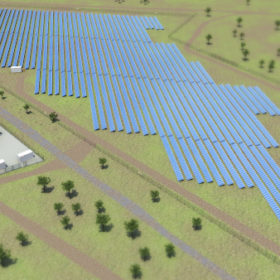
To be built on a 2,946 hectare site near Armidale, the Metz Solar Farm will have a generation capacity of 115 MW (143.5 MWdc) and is expected to implement single-axis tracking, SMA inverter stations and tier-1 solar modules to generate enough energy to supply up to 40,000 homes. In addition, it’s estimated the annual greenhouse gas emissions reduced by the solar farm will be approximately 225,000 tonnes of CO2 equivalent.

Construction on the project was originally slated for 2018 but it has faced numerous delays amid broad industry concerns about securely integrating new solar and wind projects into the grid.

Frigerio has previously said that delays due to grid connection issues, transmission constraints and construction costs “were typical issues that solar developers are generally facing in the market, but this is not impacting or expected to impact our committed projects”.

The Metz Solar Farm has already secured approval for its grid connection from the Australian Energy Market Operator (AEMO) and a substation has been completed by Transgrid. The project is also underpinned by a power purchase agreement (PPA) with Snowy Hydro, signed in 2018 as part of the Snowy Hydro Renewable Energy Procurement Program.

FRV, part of Saudi Arabian operation Abdul Latif Jameel Energy, said it would now take the project on to financial close with construction expected to commence in the coming months.

The Metz Solar Farm delivers the third PPA with Snowy Hydro for FRV, adding to deals inked for the 90 MW Sebastopol and the 69.75 MW Goonumbla solar farms.

The Sebastopol project, located in southwestern New South Wales, is currently under construction while the Goonumbla Solar Farm, near Parkes, was completed in August and is now connected to the national grid. The 56 MW Moree Solar Farm rounds out FRV’s NSW portfolio of large-scale PV projects.

FRV’s website said the company also operates two sites in Queensland, the 125 MW Clare Solar Farm and the 100 MW Lilyvale Solar Farm, which is under construction. Also in the company’s portfolio is the 85 MWWinton Solar Farm in Victoria and the 125 MW Chaff Mill Solar Farm in South Australia.


Lắp đặt điện mặt trời Khải Minh Tech
https://ift.tt/2X7bF6x
0906633505
info.khaiminhtech@gmail.com
80/39 Trần Quang Diệu, Phường 14, Quận 3
Lắp đặt điện mặt trời Khải Minh Tech
https://ift.tt/2ZH4TRU
China’s ‘Liquid Sunshine’ project demonstrates PV powered methanol

A pilot project in China was brought online this month, combining 10 MW of PV with electrolyzers for hydrogen production and carbon dioxide hydrogenation to synthesize methanol. The methanol is supplied to the chemical industry, or can be converted back into hydrogen for energy use. And the project’s creators say their next goal is scaling the project up to 10 or even 100 times its current size.

Scientists led by the Dalian Institute of Chemical Physics (DICP) in China have begun a large-scale project demonstrating PV powered production of hydrogen, which is then used to convert carbon dioxide into methanol. The demonstration project was certified by China’s Petroleum and Chemical Industry Federation and is expected to run for 10 months, with plans for expansion further down the line.

The “Liquid Solar Fuel Production demonstration Project” combines a 10 MW PV array with an electrolyzer and equipment for CO2 hydrogenation. The electrolyzers utilize an undisclosed catalyst developed at DICP, which it describes as a “low-cost and long-lifetime electrocatalyst for alkaline water electrolysis.” According to the institute, the facility currently has capacity to produce 1,000 cubic meters of hydrogen per hour and requires less than 4.3 kWh of electricity per cubic meter.

Hydrogen is then used to convert CO2 into methanol, driven by another catalyst, this time a mixed metal oxide. DICP reports that the demonstration facility currently has capacity to produce 1,000 tons of methanol per year, reaching 99.5% purity.

Expansion plans

“Our overall goal is to eliminate CO2 emissions by utilizing CO2 as a carbon source alongside renewable energy,” DICP Professor Can Li told pv magazine. “The next plan is to expand the scale from 1,000 ton-methanol/y to 10,000 ton-methanol per year, or even a 100,000 ton-methanol per year.”

Methanol produced at the plant can be supplied to the chemical industry, or stored and used to produce hydrogen again. And despite the major expansion plans, Li points out that the project is ultimately a technology demonstration, and does not come with a detailed business model at this stage.

Large-scale, PV powered hydrogen production is gaining ground commercially, with projects announced recently in the Middle East and Australia, but still struggles with high costs and lack of infrastructure to make good use of the hydrogen. Using the hydrogen in CO2 conversion to methanol meanwhile, has shown promise but remains largely in the research stage.


Lắp đặt điện mặt trời Khải Minh Tech
https://ift.tt/2X7bF6x
0906633505
info.khaiminhtech@gmail.com
80/39 Trần Quang Diệu, Phường 14, Quận 3
Lắp đặt điện mặt trời Khải Minh Tech
https://ift.tt/2ZH4TRU
Steel producer Nucor signs massive PPA for 250 MW of new solar energy in Texas

Nucor Corporation announced that it has signed a 15-year Virtual Power Purchase Agreement (VPPA) with EDF Renewables North America (EDFR) for 250 MWAC of new solar energy in Texas. The agreement, which will enable EDFR to add more clean energy to the region’s power grid, is Nucor’s first VPPA and the largest of its kind…

The post Steel producer Nucor signs massive PPA for 250 MW of new solar energy in Texas appeared first on Solar Power World.


Lắp đặt điện mặt trời Khải Minh Tech
https://ift.tt/2X7bF6x
0906633505
info.khaiminhtech@gmail.com
80/39 Trần Quang Diệu, Phường 14, Quận 3
Lắp đặt điện mặt trời Khải Minh Tech
https://ift.tt/2ZH4TRU
Jigar Shah: Policy action and tech deployments needed for power sector innovation

“We’ve averaged 2.4 cents a kilowatt hour for the last six months for PPAs. That’s actually too low. I think we would be fine at 3.4 cents… I don’t think that solar and wind industries would skip a beat [without their tax incentives], and they have other policy mechanisms.”

From pv magazine USA

“Once you get to a certain level of maturity of a technology, the only way to really achieve cost reduction is through deployment of that technology, and the more deployment that you put out there, the more micro innovations are allowed to come into the space,” Jigar Shah, the co-founder of Generate Capital, said during a discussion on deployment-led innovation for sustainable infrastructure hosted by the Institute of Electrical and Electronics Engineers (IEEE) Santa Clara Valley Sustainability Chapter.

Although deployment-led innovation is often aided by rebates and tax incentives that can pull down costs, these incentives can also outlive their usefulness.

“Solar and wind technologies are basically crowding out other technologies [because of the tax incentives they receive]… We are not going to decarbonize our entire economy without at least 50 to 100 technologies – not just two,” Shah said.

“We’ve averaged 2.4 cents a kilowatt hour for the last six months for PPAs. That’s actually too low. I think we would be fine at 3.4 cents… I don’t think that solar and wind industries would skip a beat [without their tax incentives], and they have other policy mechanisms,” Shah said.

Other technologies

In the power sector, there are lots of other innovative technologies – like anaerobic digesters, small-scale hydro, fuel cells, geothermal technologies and battery storage demand response load control technologies – just sitting on the shelf. Hydrogen, which is already a roughly $130 billion business globally, also doesn’t need much in the way of innovation at its most fundamental industry level, Shah said, pointing out that hydrogen is growing 4% or 5% a year.

Because hydrogen is used in the making of chemicals and fertilizer and in the processing of oil and gas, excess electricity that is turned into hydrogen can be shifted and sold into these other markets. For renewable developers, this can be helpful during a protracted low price cycle, and for industrial companies that are heavy emitters, this could help them transition to a low-carbon economy. Hydrogen’s exhaust is water.

Policy and follow-through matter

Right now, about half of the U.S. transmission system is used less than 30% of the time because the system was built out to be able to handle the greatest possible demand, not daily load. “We are spending $37 billion dollars a year now on building out new transmission and new distribution. Only about $14 billion of that is transmission; the rest is distribution,” Shah said.

“It [would be] cheaper to pay people to have flexible load that is controlled by a third party than it [would be] to build out more distribution lines… We just need to reform our grid into a whole new set of rules,” he said.

Similarly, on the solar panel and battery recycling side, an extended producer responsibility approach – which makes the manufacturers of future waste responsible for disposal on behalf of their customers – could help. “It’s far more cost effective for manufacturers to be forced to work together, to own recycling facilities in a joint fashion, where they try to greatly reduce the cost of all that collectively. That happens through policy. It doesn’t happen through people opting in,” Shah said.

“All of us [need] to recognize that politics is one thing, but policy is critical to all the systems that we interact with,” Shah said.

“The U.S. government procures $4 billion of electricity per year. They could actually sign a contract for probably 50,000 megawatts of PPAs for renewable energy using existing contracting. It would probably take three years of red tape to get it done, but I think it’s worth doing,” he said, explaining that a corporate PPA that the federal government can use for this has been around since 2007.

Follow through is also important. The Obama Administration said that the U.S. should buy all electric vehicles for its fleet, but not a single one was purchased, Shah added.


Lắp đặt điện mặt trời Khải Minh Tech
https://ift.tt/2X7bF6x
0906633505
info.khaiminhtech@gmail.com
80/39 Trần Quang Diệu, Phường 14, Quận 3
Lắp đặt điện mặt trời Khải Minh Tech
https://ift.tt/2ZH4TRU
SMA America launches #PVPioneers contest to celebrate 20-year anniversary

This year marks the 20th Anniversary for SMA America. German-based SMA Solar Technology has been in business since 1981, expanding into the United States two decades ago. Over that time, SMA America has established itself as an industry pioneer in solar technology and photovoltaic inverters for clients and partners. Founded in a small town in…

The post SMA America launches #PVPioneers contest to celebrate 20-year anniversary appeared first on Solar Power World.


Lắp đặt điện mặt trời Khải Minh Tech
https://ift.tt/2X7bF6x
0906633505
info.khaiminhtech@gmail.com
80/39 Trần Quang Diệu, Phường 14, Quận 3
Lắp đặt điện mặt trời Khải Minh Tech
https://ift.tt/2ZH4TRU

Dynamic Energy Solutions begins construction on solar project for The Miyoshi Kasei Group

Dynamic Energy

Solar photovoltaic panels arrive waiting to be erected for a 842 kilowatt ground mount system at Miyoshi America’s manufacturing facility in Dayville, CT.

Miyoshi America, a leading manufacturer for the global cosmetics industry is building a ground-mounted solar system at its manufacturing facility and US headquarters in Dayville, Conn., with Dynamic Energy Solutions. The 842 kilowatt system is projected to meet 38% of the facility’s annual energy needs. By partnering with Dynamic Energy, a full-service solar energy solutions provider, Miyoshi America was able to collaborate throughout the design process to customize specific site needs, while maximizing their operational goals.

“The Miyoshi Kasei Group’s goal is to provide products and services that offer peace of mind and safety to consumers and that are friendly to both society and the environment. We are committed to implementing initiatives that will protect the environment in harmony with local communities” said Tim Takagi, President of Miyoshi America.

When completed, the ground mounted solar array will generate over 1.13 megawatt hours of energy in its first year, enough to offset approximately 798 metric tons of carbon dioxide, equivalent to the amount of carbon sequestered by 1,042 acres of U.S. forest each year.

“Dynamic Energy is honored to announce this partnership with Miyoshi America, and commends their entire leadership team for the collaboration, vision, and dedication with which they have approached this project. Their solar investment provides a positive example for Connecticut manufacturers who want to benefit the environment while improving the bottom line,” said Tim Carr, Vice President of Business Development at Dynamic Energy.

-- Solar Builder magazine


Lắp đặt điện mặt trời Khải Minh Tech
https://ift.tt/2X7bF6x
0906633505
info.khaiminhtech@gmail.com
80/39 Trần Quang Diệu, Phường 14, Quận 3
Lắp đặt điện mặt trời Khải Minh Tech
https://ift.tt/2ZH4TRU

Direct Energy Business signs PPA with Cardinal Renewables for 14-MW Virginia solar project

Cardinal Renewables, a strategic partnership between the global investment firm, The Carlyle Group, and Alchemy Renewable Energy, an industry leader in renewable energy projects and tax equity financing, has secured a PPA with Direct Energy Business, one of North America’s largest retail providers of electricity, natural gas and home business energy-related services, through Twittys Creek…

The post Direct Energy Business signs PPA with Cardinal Renewables for 14-MW Virginia solar project appeared first on Solar Power World.


Lắp đặt điện mặt trời Khải Minh Tech
https://ift.tt/2X7bF6x
0906633505
info.khaiminhtech@gmail.com
80/39 Trần Quang Diệu, Phường 14, Quận 3
Lắp đặt điện mặt trời Khải Minh Tech
https://ift.tt/2ZH4TRU

Oxford PV’s German module factory backed by Brandeburg state with €8.8 million

Oxford PV is currently building a manufacturing facility for its silicon perovskite tandem solar cells in Brandenburg an der Havel.

From pv magazine Germany

Oxford Photovoltaics (PV) Germany GmbH, the German unit of UK-based solar module manufacturer Oxford PV, is currently investing around €44 million in the construction of its factory in Brandenburg an der Havel, in the eastern German region of Brandenburg. The state Ministry of Economics in Potsdam is funding the project with €8.8 million.

“I am delighted that Oxford Photovoltaics has brought the solar technology developed by the company itself to market maturity and that it will soon start with industrial series production here in Brandenburg,” said Brandenburg Minister for Economic Affairs Jörg Steinbach. “The decision by Oxford PV to expand the production facility in Hohenstücke is a clear commitment to our community.”

Oxford PV is currently building a manufacturing facility in Brandenburg an der Havel for its highly efficient silicon perovskite tandem solar cells. The photovoltaic manufacturer acquired the Bosch factory in 2017 and has since operated a pilot line to bring its technology to market maturity.

Mass production is scheduled to start in the middle of next year, as CEO Frank Averdung recently told pv magazine. The production facility will initially have a capacity of 125 MW. The photovoltaic company wants to expand production by 2024 and then produce its highly efficient tandem cells on a gigawatt scale.


Lắp đặt điện mặt trời Khải Minh Tech
https://ift.tt/2X7bF6x
0906633505
info.khaiminhtech@gmail.com
80/39 Trần Quang Diệu, Phường 14, Quận 3
Lắp đặt điện mặt trời Khải Minh Tech
https://ift.tt/2ZH4TRU

Changing the face of solar tech

By Lori-Ann Livingston, marketing and business development, Boxbrite Technologies A solar tech company based in Ontario, Canada, has discovered the value of a diverse workforce, as well as its challenges and benefits. Boxbrite Technologies develops software solutions for renewable energy systems. 70% of the company’s workforce is made up of highly skilled, highly educated newcomers…

The post Changing the face of solar tech appeared first on Solar Power World.


Lắp đặt điện mặt trời Khải Minh Tech
https://ift.tt/2X7bF6x
0906633505
info.khaiminhtech@gmail.com
80/39 Trần Quang Diệu, Phường 14, Quận 3
Lắp đặt điện mặt trời Khải Minh Tech
https://ift.tt/2ZH4TRU

Non-stop worldwide PV-powered yacht race

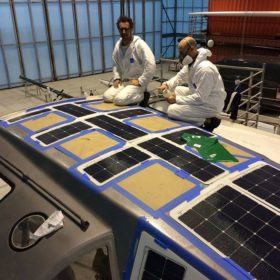
The ninth edition of the Vendée Globe began on Nov. 8 from the French port of Sables-d'Olonne, for a complete world tour without stopovers or assistance. PV panel maker Solbian equipped several competitors with its flexible products.

From pv magazine France

The ninth edition of the Vendée Globe began on Nov. 8 from the French port of Sables-d'Olonne, for a complete world tour without stopovers or assistance. Italian PV panel maker Solbian equipped several competitors with its flexible products.

The competitors include Didac Costa, who is competing in his second Vendée Globe. He has 780 Wp of solar panels mounted on his One Planet One Ocean vessel. And Boris Herrmann of Germany has a 1,149 Wp solar PV system by Solbian on his boat. It features two different types of cells, for a total weight of just 24.5 kg.

“The Solbian solar panels have proven to be very effective in preparing for the Vendée Globe,” Herrmann said. “Together with the hydro generator, they keep the boat's batteries charged, avoiding carrying fuel to generate electricity – which will directly contribute to racing performance. From an ecological point of view, the system will also play a crucial role in meeting this challenge without resorting to fossil fuels.”

Ari Huusela chose 390 Wp SP series panels for his Stark vessel, with rear contact cells capable of converting more than 24% of sunlight into electricity.

“In a competition like the Vendée Globe – a solo round the world race without stopovers or assistance – energy management is an important aspect, which is why we need solutions capable of withstanding the conditions. the most extreme, ” Huusela said. “The solar panels that I have installed have been designed and tested for the nautical industry, have a low weight and will be an essential source of clean energy to meet the consumption on board.”

Solbian  produces flexible solar panels at its factory in Avigliana, in the Italian province of Turin. Solbianflex panels are particularly suitable for sailboats, but they can also be used in e-mobility applications and motorhomes.


Lắp đặt điện mặt trời Khải Minh Tech
https://ift.tt/2X7bF6x
0906633505
info.khaiminhtech@gmail.com
80/39 Trần Quang Diệu, Phường 14, Quận 3
Lắp đặt điện mặt trời Khải Minh Tech
https://ift.tt/2ZH4TRU

Solar micro-grid with 1 MW/4 MWh of vanadium redox flow storage in South Africa

Spanish renewable energy company Abengoa will deploy a 3.5 MW solar micro-grid at a vanadium mining site operated by Bushveld Minerals in South Africa. The storage system will be provided by Austria-based storage specialist Enerox Holdings Limited.

Abengoa will deploy a 3.5 MW solar micro-grid linked to a 1 MW/4 MWh vanadium redox flow storage unit at Vametco Alloys mine, a vanadium mine owned by South African vanadium producer Bushveld Minerals in North West, an inland South African province that borders Botswana.

The storage system will be provided by Austria-based storage specialist Enerox Holdings Limited, which is a unit of Bushveld Minerals. “This project is part of Bushveld's strategy to improve the stable supply of energy in the African continent, as well as to develop and promote the role of vanadium in the growing global market for energy storage through vanadium redox flow batteries, considered a general trend in long-term storage,” Abengoa said in a statement.

The project, according to the Spanish developer, is the world's largest hybrid solar plant incorporating vanadium redox flow storage.

“The hybrid mini-grid project will supply just under 10% of Vametco's electrical energy consumption at any one time and will demonstrate the technical and commercial capability of hybrid mini-grids using solar PV and VRFB technology,” Bushveld Minerals stated in a separate statement. “Technically, the system will be able to operate independently or jointly, either as standalone systems or as a fully functional mini-grid installation.”

Bushveld Minerals added that the project was structured as a separately funded independent power producer that will sell the electrical energy to the mine, and that it is aimed at reducing the mine's reliance on troubled South African utility Eskom. As a result, the Vametco hybrid mini-grid project installation will be one of the first solar generation projects with long-duration storage to be financed, off-balance sheet, in Africa.

According to the mining company, Enerox has installed more than 136 vanadium redox flow batteries and 23 MWh of energy storage capacity to date.


Lắp đặt điện mặt trời Khải Minh Tech
https://ift.tt/2X7bF6x
0906633505
info.khaiminhtech@gmail.com
80/39 Trần Quang Diệu, Phường 14, Quận 3
Lắp đặt điện mặt trời Khải Minh Tech
https://ift.tt/2ZH4TRU

Radiative cooling for CPV systems

Scientists in the United States have tested soda-lime glass radiative coolers in a CPV system and claim these can reduce the device operating temperature by 5 to 36 degrees Celsius. This may result in an increase in the solar cell's open-circuit voltage of between 8% and 27%.

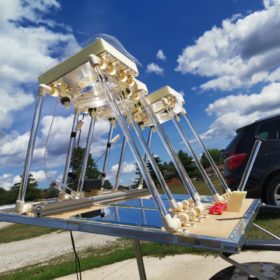
Scientists at Purdue University have demonstrated a CPV system integrated with radiative coolers which they claim can operate at a lower temperature and higher open-circuit voltage compared to common CPV devices based on gallium antimonide (GaSb) solar cells.

In their prototype, the researchers tested three different cooling structures under a range of wind speeds and solar heat loads. “We also conducted multiple outdoor experiments covering the worst and best possible working scenarios for radiative cooling to check the overall performance,” they explained.

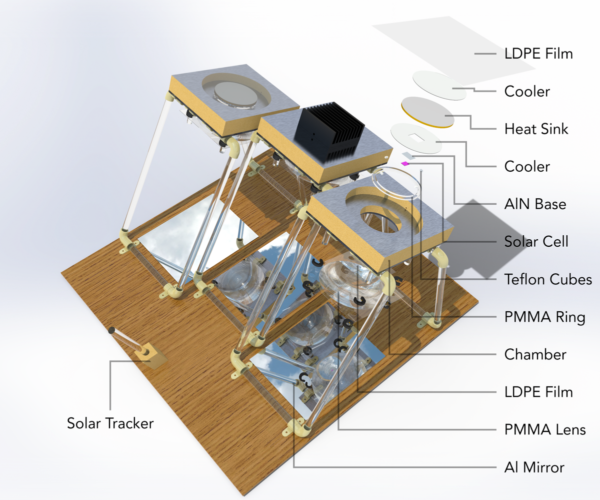
Two soda-lime glass radiative coolers were deployed on both sides of the CPV system's heat sink. The test was conducted on a measurement platform consisting of three chambers equipped with a Fresnel lens with an effective diameter of six inches and aluminum mirrors. A first chamber contained the CPV device with the coolers and a second chamber hosted an identical system without the cooling tech. The first chamber had a sealed-chamber structure with top low-density polyethylene (LDPE) films, while the second had an open structure. The first configuration, according to the research team, reflected the zero wind speed working condition of CPV, as the LDPE film can cut off direct convection from the heat sink to ambient air.

Schematic of the three chambers used for the experiment.

Image: Purdue University

A third chamber only had a thermal power sensor to monitor the incident solar power.

“Upon direct solar heating, temperatures rose significantly in both chambers, thus reducing for both cells at different rates,” the scientists stressed. “More specifically, the temperature of Chamber 1 (with coolers) increased more slowly than the temperature of Chamber 2 (without coolers), as expected.” The average focused solar irradiance during the experiment was around 6.1 W, corresponding to a direct normal irradiance (DNI) of 1,019 W/m.

This ensured that the temperature in the GaSb cell range dropped by a minimum of 5 to a maximum of 36 degrees Celsius. “To our knowledge, the maximum temperature drop even outperformed some active air cooling methods,” the academics stated.

The temperature decrease provided by the cooling system has resulted in an increase in the cell's open-circuit voltage of between 8% and 27%. “The results clearly show that radiative cooling benefits all cases, despite variations in heat sinks and weather conditions,” they also specified.

The US group claims that the temperature drops provided by the radiative cooling technique may significantly improve the lifetime of CPV systems. “With radiative cooling, PV can work under higher solar concentrations at the same temperature, to potentially improve efficiencies and power outputs,” they concluded. “We hope that this work can help to motivate further studies on commercially relevant CPV cooling designs, as well as other systems, which may benefit from radiative cooling.”

The radiative cooling technique is presented in the paper Lightweight, Passive Radiative Cooling to Enhance Concentrating Photovoltaics, published in Joule.


Lắp đặt điện mặt trời Khải Minh Tech
https://ift.tt/2X7bF6x
0906633505
info.khaiminhtech@gmail.com
80/39 Trần Quang Diệu, Phường 14, Quận 3
Lắp đặt điện mặt trời Khải Minh Tech
https://ift.tt/2ZH4TRU

This is your SolarWakeup for November 13th, 2020

Market Analysis Conference Call. In a few hours you can join me and other solar pros as we talk about the the current state of the solar market. We’ll talk about the election, ITC, supply chain shortages and more. Call is open to anyone for free, you can register here

The Top 3 Policies. I asked Abby Hopper what the top three policy issues were in the next Congress and White House. First was the ITC, getting it extended and hopefully back to 30% with the addition of energy storage. Second was trade, fixing it and improving it to make domestic manufacturing thrive. Third came in two parts but with the same intention of putting more solar under the sun. 3a is the lack of efficiency in the interconnection process for solar farms, we’ve talked about how bad the interconnection queues are right now. 3b is permitting for residential solar, with the goal of making it digital, standardized and instant. Listen to the whole conversation here.

Trillion Dollar Voice. This is a big deal, BlackRock’s Larry Fink is publicly backing mandatory climate reporting by corporations. This is a risk issue, companies that have thousands of employees in a single location for example could be at risk if a natural disaster becomes more common. It also ensures that companies are thinking about future regulatory issues around pollution and explaining to investors what steps they are taking to mitigate this.

Ford And Rivian Week. Rivian is releasing their configurator next week if you put the deposit down and the week after if you haven’t. The 300 mile range SUV and pickup truck definitely has my eye from an appeal standpoint, they definitely should let me get a press ride in. More relevant to many of you, Ford announce an electric version of their popular work van, Transit. Around $50k for the  125 mile range work vehicle could be ideal for solar installers.

Enjoy Your Weekend! Have Friday the 13th! Check out the Buyer’s Group price list if you haven’t 

Opinion

Best, Yann

The post This is your SolarWakeup for November 13th, 2020 appeared first on SolarWakeup.com.


Lắp đặt điện mặt trời Khải Minh Tech
https://ift.tt/2X7bF6x
0906633505
info.khaiminhtech@gmail.com
80/39 Trần Quang Diệu, Phường 14, Quận 3
Lắp đặt điện mặt trời Khải Minh Tech
https://ift.tt/2ZH4TRU