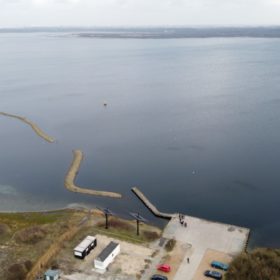
Dutch research center TNO is setting up a test facility for floating PV plants in Oostvoornse, where it will analyze the impact of wind and waves on floating structures and module yield. TNO Senior Project Manager Jan Kroon told pv magazine that it will assess module damage and the impact of waves on light absorption. It has already found that the ratio between wave-height and wave-length is a key factor in mismatch losses, while noting that optimizers and micro-inverters on panels could mitigate losses.
The Netherlands Organisation for Applied Scientific Research (TNO) is studying the impact of wind and waves on the performance of floating solar systems at a special testing facility at Oostvoornse, a lake that is located near Maasvlakte, an artificial extension of the Europoort industrial facility at the port of Rotterdam.
“Our first focus is on the integrity of the floating structure,” Jan Kroon, senior project manager at TNO, told pv magazine, noting that constant movement can cause damages. If the frequency of waves is in the same domain as the resonant frequencies of the floating structures, there is a high chance of failure.
Small waves
“The Oostvoornse lake experiences wave-class 2 conditions, which means waves of up to 1 meter may be expected under heavy storm conditions,” Kroon said.
The amount of stress on the modules depends on structural design, he explained, noting that the field test at Oostvoornse will focus on three different designs. “One of the research topics is to find out if different stresses on the modules can lead to module damage,” Kroon said.
TNO will also study different mooring systems at the facility. “Mooring is a very important aspect of floating PV,” Kroon added. “The impact of wind and waves on the mooring will be monitored in this project.”
Wave force
Most floating PV projects thus far have been installed on relatively calm bodies of water. But in the future, floating PV developers will install more systems on larger bodies of water and in saltwater conditions, where bigger wave conditions are common. This can also have an impact on light absorption and module yield.
“If modules are mounted on small floats, such as many one-module-per-float designs, and the floats follow the movement of the waves, the individual modules will have different orientations towards the sun,” Kroon explained. “This can lead to mismatch losses and these losses could be in the order of a few percent.”
TNO has developed a model to calculate these losses on an annual basis, with losses reaching up to 9% for locations with extreme wave intensity, 7% for locations with high wave intensity, and 3% for locations with medium wave intensity. The ratio between wave height and wave length is also a dominant driver in such mismatch losses, but optimizers and micro-inverters on individual panels can mitigate such losses, the researchers said.
Offshore options
However, such losses will be more significant in offshore environments, where waves are higher and winds are stronger. Thus far, TNO has mainly studied floating PV systems on challenging inland bodies of water.
“The area that could be available at sea for deploying solar parks is enormous and therefore the concept of off-shore solar is very interesting for the longer term,” Kroon said, adding that offshore conditions are much more challenging. “Research is going on explore concepts that could be suitable for this application.”
TNO is now working on the Solar@Sea project, which is funded by the Dutch government in cooperation with startup Oceans of Energy. The group aims to install its first offshore PV pilot system on the North Sea later this year. The pilot project, which was launched in February 2018, also involves the Energy Research Center of the Netherlands (ECN), the Maritime Research Institute Netherlands (MARIN), and Abu Dhabi National Energy Co. The first section of the pilot plant was finalized in December.
Kroon said he is confident that researchers will develop PV technologies that can withstand harsh sea conditions. “We are positive that withstanding the conditions offshore is possible for floating PV but the main challenge is to come up with a design that is reliable for decades at sea for a competitive price,” he said.
Testing facility
The PV arrays at the Oostvoornse testing facility will range up to 50 kW in size. TNO will monitor the systems for their electrical performance, while MARIN will study hydrodynamic issues. The HZ University of Applied Sciences, meanwhile, will look at the ecological impact of such systems for at least one year. All of the test arrays will all be connected to the grid.
From a list of 12 candidates, TNO experts have chosen Texel4Trading/SolarFloat (Netherlands), SolarisFloat (Portugal) and Isifloating by Isigenere (Spain) to build the floating systems.
“The plan is to commission the systems during summertime , after which we will start the monitoring,” Kroon said. “We have of course uncertainties and chances of delay of planning because of the coronavirus crisis.”
Another floating PV systems is also now under development at Oostvoornse. In April 2019, Rijkswaterstaat – the water management agency of the Netherlands – launched market consultations for a 100 MW floating solar tender. The Zon op de Slufter project will be developed in cooperation with the Central Government Real Estate Agency (Rijksvastgoedbedrijf) and the port of Rotterdam.
The Netherlands is a hotbed for the development of utility-scale floating PV systems. In February 2019, the Dutch Foundation for Applied Water Research published guidelines and tools for developers who are interested in floating PV projects across the country. It announced its first floating solar project in September 2017.
Lắp đặt điện mặt trời Khải Minh Tech
https://ift.tt/2X7bF6x
0906633505
info.khaiminhtech@gmail.com
80/39 Trần Quang Diệu, Phường 14, Quận 3
Lắp đặt điện mặt trời Khải Minh Tech
https://ift.tt/2ZH4TRU

Không có nhận xét nào:
Đăng nhận xét